So there’s this discussion that pops up periodically in poly circles, about whether polyamory is a sexual orientation. Amidst a great deal of fuss and flame (this is the Internet, after all) folks generally get polarized into two camps—those who feel that polyamory is a philosophy or lifestyle choice, and those who claim it as their identity, and feel like they’re just ‘wired that way’, many (but not all) of whom classify their need to relate multiply right alongside their sexual preferences. A great deal of argument over whether poly people belong in queer spaces generally ensues. (I’m young enough that ‘queer’ doesn’t carry connotations of a slur for me, and it’s my preferred inclusive term for the delightful alphabet soup that is the rainbow community: https://ok2bme.ca/resources/kids-teens/what-does-lgbtq-mean/ so I’ll be using it in this piece.)
That’s a big question. Do poly people, who may otherwise be cisgender and straight, belong in queer spaces by virtue of their marginalized relationship orientation? You can probably guess that I believe the answer to be no. Poly folk and queer folk may be natural allies, and certainly there is a great deal of intersection between the two communities, and plenty of people who identify as both (including yours truly)… but they’re not the same thing, and I believe it’s important to make a distinction between them.
Now, a relationship orientation is certainly part of one’s identity. And a polyam orientation is demonstrably marginalized. Poly folk often deal with similar worries to members of the queer community about coming out, or losing custody battles, or facing discrimination on the basis of their ‘lifestyle’. But polyamory is not a sexual orientation or a gender identity. It is a relationship orientation. And while the freedoms to build one’s relationships in whatever configuration suits the people involved is equally deserving of protection from discrimination as any other freedom, it is an additional facet of one’s identity, not the same thing as a sexual orientation or gender identity.
Did you ever consider that you have a relationship orientation? Our dominant culture assumes the default of monogamy so thoroughly, most people haven’t even thought about it. People are seen to be monogamous, or to be failing at monogamy, and those are the only choices presented. But there is a lot more out there!
The More Than Two Glossary of Poly Terms defines a relationship orientation as “a preference for sexual or loving relationships of a particular form; as, for example, a preference for relationships that are monogamous, for relationships that are polyfidelitous, for relationships that are polyamorous, and so forth.”
I particularly appreciate the emphasis on relationship orientation describing the form of one’s “sexual or loving relationships”, as that expands the potential for asexuals and aromantics to be included in polyamory (as they certainly are) and for one’s own poly network, polycule, or poly family (whatever terminology you prefer) to encompass those relationships which are emotionally intimate, maybe even practically or financially entwined, but not sexual. I certainly have friends I consider family—family of choice—and they are fully as important a part of my web of connections as anyone I might choose to be with in a sexual relationship. I have lived with some of them, and gladly.
Rather than putting together a laundry list of relationship orientations for you to consider and meticulously defining what each might or might not include, let’s take a look at the kinds of questions that go into defining how you might structure your personal web of relationships.
Ignore, for a moment, the script you’ve been handed. This script dictates a singular opposite-sex partner, kids, a joint bank account and a suburban house. It suggests that you and your one partner are expected to focus on just ‘the couple’ and prioritize that over your friendships, and encourages sexual jealousy to police that line. Instead, imagine discussing and deciding about all of these points. Do you and your prospective partner want to have kids together, or might they like to help raise kids of yours without taking on full parental responsibility? Do the two of you want to live together? Would that be with just the two of you, or would you prefer more adults in the household? Will you share finances? Have sex? Be sexually exclusive? Cultivate romance? Be romantically exclusive? If either of you has more than one partner, how might you choose to apportion your energy and time between them? The idea that these are real choices, and that happy and healthy relationships can develop through exploring these questions, even if the collective answers don’t look like the mainstream idea of ‘relationship success,’ is what it looks like to explore alternative relationship structures, and to be open to the idea of more than one relationship orientation.
Further commentary on relationship orientations from More Than Two Glossary of Poly Terms adds, “Just as some people feel that their sexual orientation is fluid and a matter of choice where other people feel that their sexual orientation is fixed and not subject to choice, so do some people feel that their relationship orientation is subject to choice whereas others feel their relationship orientation is not a matter of choice. It has been my observation that some people seem to be inherently monogamous, and can’t be happy any other way; some people seem to be inherently polyamorous, and can’t be happy any other way; and some people seem to be able, under the right circumstances and with the right partners, to be happy in a monogamous or a polyamorous relationship.”
Personally, I’d count myself in that last group, as someone, who under the right circumstances and with the right partners, can be happy in a monogamous or polyamorous relationship. But my mindset is irrevocably poly. I ask the questions instead of going with the unexamined default settings. (This is something I plan to return to in an upcoming post.)
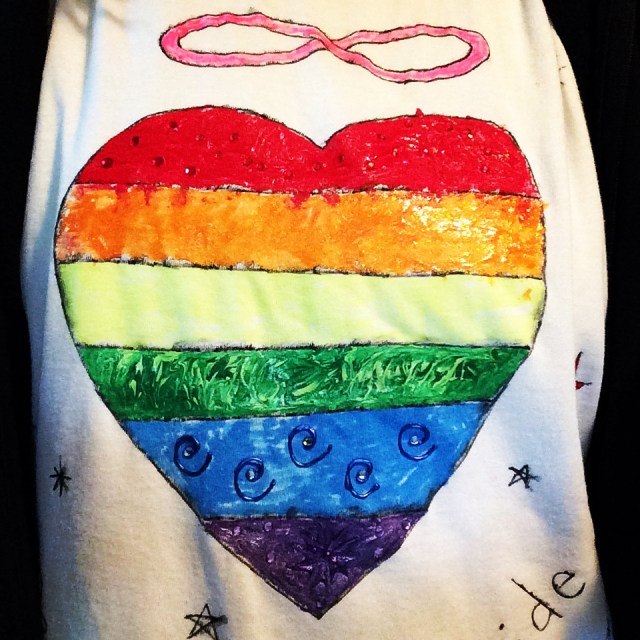
Having done this work of self-examination, I gladly claim polyamory as my relationship orientation. This is how I’m choosing to structure my life and my relationships, consciously and for the benefit of everyone involved. To me, that choice is a choice to be true to my skills, capacities, joys, and desires. This is what fits me best and feels most authentic. It’s most definitely part of my identity. And I’ll be cheering on all my beautiful queer rainbow siblings in the Pride parade, come Saturday. But if I march, I march in support, or speaking from my queer identity, and not my polyam identity. And that feels like an important distinction to make.
 Living Vividly